

Oasis Agri Prescription Blended Trace Elements Nutrients and Functions – Part 1
BORON (B)
Functions in Plants and Soil:
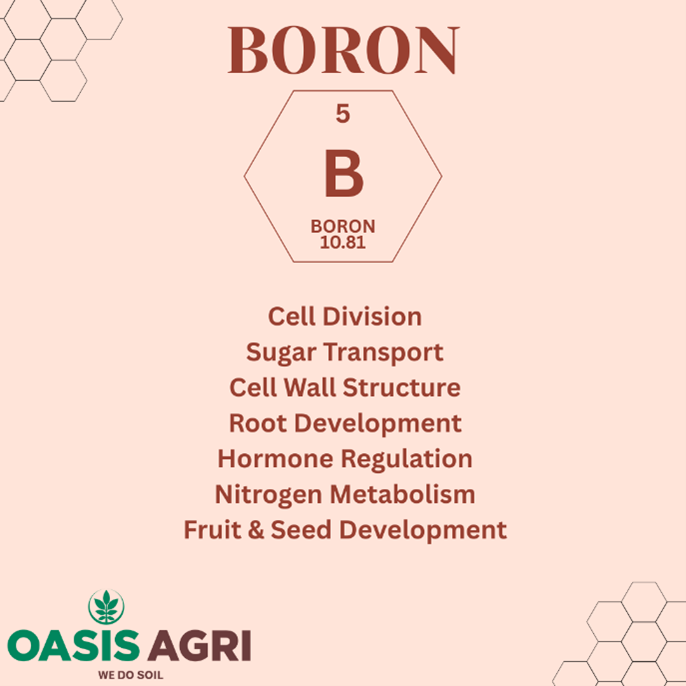
- Cell Division:
Important for cell division, especially at growth points. Boron is primarily found in meristematic tissues (actively growing areas), reproductive tissues and leaves.
- Sugar Transport:
Boron helps move sugars produced during photosynthesis from leaves to other parts of the plant, including growing tissues and developing fruits.
- Cell Wall Structure:
Boron is a structural component of cell walls, providing strength to the plant
- Root Development:
Boron is critical for cellular division and root elongation.
- Hormone Regulation:
Boron is involved in various hormone functions in a plant. It helps to balance hormones like auxin which impact plant growth.
- Nitrogen Metabolism:
Boron is especially important for nitrogen fixation in legume crops. It is required for rhizobia nodule development along legume roots.
- Fruit & Seed Development:
Boron is vital to reproductive processes including pollen viability and germination, pollen tube elongation, fruit and seed development.
Deficiency Symptoms in Plants:
Note: Deficiency symptoms can present differently depending on the crop species
Boron is an immobile plant nutrient. Symptoms therefore will typically occur in the youngest leaves and growth points.
- Plant Growth:
Stunted and/or distorted growth.
- Leaf Symptoms:
- Young leaves may be small, curled, thickened or distorted.
- Brittle texture, cracked stems and leaf midribs.
- Interveinal yellowing or reddish-purple discolouration.
- Growth Points:
- Severe deficiency can lead to death of growth points.
- Flowers and Fruit:
- Poor or failed bud development.
- Reduced or failed flowering or fruiting.
- Deformed, cracked or discoloured fruit.
- Poor seed quality.
- Roots:
- Shortened, thickened, stubby roots with darkened or necrotic tips.
- Internal browning in root vegetables.
- Crop Specific:
- Maize:
- Shortened internodes.
- White or yellow spots on upper leaves,
- White streaks along length of leaves.
- Deformed cobs with incomplete filling.
- Shortened or absent silks.
- Tomatoes:
- Hollow or “puffy” fruits, and shoulder cracking.
- Spotting on fruit.
- Fruit:
- Apples: Internal “water core”.
- Pears: Dieback of new shoots and hard brown flecks inside the fruit.
- Brassicas:
- Stunted or distorted growth.
- Hollow stems, sometimes with a brown discoloration.
- Poor curd development in cauliflower.
- Cracked petioles and midribs.
- Root crops:
- Hollow, cracked, or discolored stems.
- Internal brown rot or discoloration.
- Rough, cankered patches on the roots.
- Maize: